

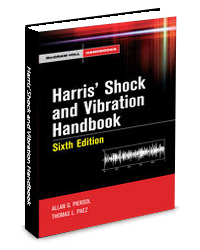
The classic reference on shock and vibration, fully updated with the latest advances in the field
Written by a team of internationally recognized experts, this comprehensive resource provides all the information you need to design, analyze, install, and maintain systems subject to mechanical shock and vibration. The book covers theory, instrumentation, measurement, testing, control methodologies, and practical applications.
Harris’ Shock and Vibration Handbook, Sixth Edition, has been extensively revised to include innovative techniques and technologies, such as the use of waveform replication, wavelets, and temporal moments. Learn how to successfully apply theory to solve frequently encountered problems. This definitive guide is essential for mechanical, aeronautical, acoustical, civil, electrical, and transportation engineers.
EVERYTHING YOU NEED TO KNOW ABOUT MECHANICAL SHOCK AND VIBRATION, INCLUDING
- Fundamental theory
- Instrumentation and measurements
- Procedures for analyzing and testing systems subject to shock and vibration
- Ground-motion, fluid-flow, wind-. and sound-induced vibration
- Methods for controlling shock and vibration
- Equipment design
- The effects of shock and vibration on humans
Table of contents
Chapter 1. Introduction to the Handbook; Chapter 2. Basic Vibration Theory; Chapter 3. Vibration of Resiliently Supported Rigid Body; Chapter 4. Nonlinear Vibration; Chapter 5. Self-Excited Vibration; Chapter 6. Dynamic Vibration Absorbers and Auxiliary Mass Dampers; Chapter 7. Vibration of Systems with Distributed Mass and Elasticity; Chapter 8. System Response to Step and Pulse Functions; Chapter 9. Mechanical Impedance/Mobility; Chapter 10. Shock and Vibration Transducers; Chapter 11. Calibration of Shock and Vibration Transducers; Chapter 12. Strain Gage Instrumentation; Chapter 13. Shock and Vibration Data Acquisition; Chapter 14. Vibration Analyzers and Their Use; Chapter 15. Measurement Techniques; Chapter 16. Condition Monitoring of Machinery; Chapter 17. Shock and Vibration Standards; Chapter 18. Test Criteria and Specifications; Chapter 19. Vibration Data Analysis; Chapter 20. Shock Data Analysis; Chapter 21. Experimental Modal Analysis; Chapter 22. Matrix Methods of Analysis; Chapter 23. Finite Element Methods of Analysis; Chapter 24. Statistical Energy Analysis; Chapter 25. Vibration Testing Machines; Chapter 26. Digital Control Systems for Vibration Testing Machines; Chapter 27. Shock Testing Machines; Chapter 28. Pyroshock Testing; Chapter 29. Vibration of Structures Induced by Ground Motion; Chapter 30. Vibration of Structures Induced by Fluid Flow; Chapter 31. Vibration of Structures Induced by Wind; Chapter 32. Vibration of Structures Induced by Sound; Chapter 33. Engineering Properties of Metals; Chapter 34. Engineering Properties of Composites; Chapter 35. Material and Slip Damping; Chapter 36. Applied Damping Treatments; Chapter 37. Torsional Vibration in Reciprocating and Rotating Machines; Chapter 38. Theory of Shock and Vibration Isolation; Chapter 39. Shock and Vibration Isolation Systems; Chapter 40. Equipment Design; Chapter 41. Human Response to Shock and Vibration;Index
Biographical note
Allan G. Piersol was an engineer in private practice, specializing in analysis of data from, and the design of structures for shock, vibration, and acoustical environments. He was a licensed engineer in both mechanical and safety engineering. The author of five books and chapter author of five additional handbooks dealing with these subjects, Mr. Piersol also taught graduate courses in mechanical shock and vibration at Loyola Marymount University in Los Angeles, California.
Thomas L. Paez, recently a distinguished member of the technical staff at Sandia National Laboratories, works as a consultant specializing in probabilistic structural dynamics and validation of mathematical models. He is the author of a text on random vibrations and many chapters and papers dealing with random vibrations, mechanical shock, and model validation. Mr. Paez frequently teaches short courses on random vibrations and mechanical shock.
Please Note: Not available for shipment outside the U.S.