

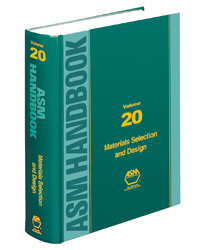
ASM Handbook, Volume 20: Materials Selection and Design fills the need for a fundamental engineering reference work that bridges the gap between design and materials engineering. It is a comprehensive reference on the basic concepts, methodologies, and information sources dealing with materials selection and its integration with engineering design processes. Contents include contributions from 100+ experts from industry and universities involved with design, materials selection, and manufacturing.
Contents
THE DESIGN PROCESS
The Role of the Materials Engineer in Design
Overview of the Design Process
Conceptual and Configuration Design of Products and Assemblies
Conceptual and Configuration Design of Parts
Creative Concept Development
Cross-Functional Design Teams
CRITERIA AND CONCEPTS IN DESIGN
Concurrent Engineering
Designing to Codes and Standards
Statistical Aspects of Design
Reliability in Design
Life-Cycle Engineering and Design
Design for Quality
Robust Design
Risk and Hazard Analysis in Design
Human Factors in Design
Environmental Aspects of Design
Safety in Design
Products Liability and Design
DESIGN TOOLS
Computer-Aided Design
Mechanism Dynamics and Simulation
Finite Element Analysis
Computational Fluid Dynamics
Computer-Aided Electrical/Electronic Design
Design Optimization
Dimensional Management and Tolerance Analysis
Documenting and Communicating the Design
Rapid Prototyping
THE MATERIALS SELECTION PROCESS
Overview of the Materials Selection Process
Techno-Economic Issues in Materials Selection
Material Property Charts
Performance Indices
Decision Matrices in Materials Selection
Relationship between Materials Selection and Processing
Computer-Aided Materials Selection
Value Analysis in Materials Selection and Design
Use of Failure Analysis in Materials Selection
EFFECTS OF COMPOSITION, PROCESSING, AND STRUCTURE ON MATERIALS PROPERTIES
Introduction to the Effects of Composition, Processing, and Structure on Materials Properties
Fundamental Structure-Property Relationships in Engineering Materials
Effects of Composition, Processing, and Structure on Properties of Irons and Steels
Effects of Composition, Processing, and Structure on Properties of Nonferrous Alloys
Effects of Composition, Processing, and Structure on Properties of Ceramics and Glasses
Effects of Composition, Processing, and Structure on Properties of Engineering Plastics
Effects of Composition, Processing, and Structure on Properties of Composites
Effects of Surface Treatments on Materials Performance
Sources of Materials Property Data and Information
PROPERTIES VERSUS PERFORMANCE OF MATERIALS
Properties Needed for the Design of Static Structures
Design for Fatigue Resistance
Design for Fracture Toughness
Design for Corrosion Resistance
Design for High-Temperature Applications
Design for Oxidation Resistance
Design for Wear Resistance
Properties Needed for Electronic and Magnetic Applications
Design with Brittle Materials
Design with Plastics
Design with Composites
MANUFACTURING ASPECTS OF DESIGN
Introduction to Manufacturing and Design
Design for Manufacture and Assembly
Manufacturing Processes and Their Selection
Modeling of Manufacturing Processes
Manufacturing Cost Estimating
Design for Casting
Design for Deformation Processes
Design for Powder Metallurgy
Design for Machining
Design for Joining
Design for Heat Treatment
Design for Ceramic Processing
Design for Plastics Processing
Design for Composite Manufacture
Control of Residual Stresses
Design for Surface Finishing
Metal Additive Manufacturing—A Review
SUPPLEMENTARY INFORMATION
Glossary of Terms: Materials Selection and Design
Abbreviations and Symbols: Materials Selection and Design