

New insights into uranium’s tricky chemistry
October 25, 2024 Source: ASM International
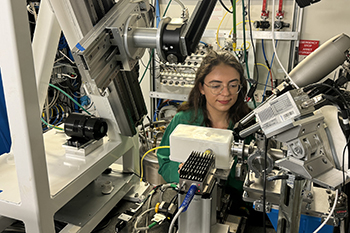
Uranium is known as the heavy metal with an intricate chemistry and diverse bonding behaviors, as well as being radioactive. Now, an international team of scientists have utilized synchrotron light at the Rossendorf Beamline (ROBL) to explore the unique properties of low-valent uranium compounds. At the European Synchrotron Radiation Facility (ESRF) in Grenoble, France, the Helmholtz-Zentrum Dresden-Rossendorf (HZDR) runs four experimental stations for radiochemical experiments.
“In our current study we were focused on low-valent uranium, which contains more electrons in its inner shells compared to other, more common uranium compounds. Specifically, we investigated the behavior of uranium’s so-called 5f electrons—electrons that, despite being located in the inner shells, play a crucial role in the element’s chemical properties. These electrons significantly influence how uranium bonds with other elements,” says Ph.D. student Clara Silva from HZDR’s Institute of Resource Ecology.
“Due to the radioactive nature of uranium, the experiments were carried out here, a facility specifically designed for actinide research. This environment provided the necessary safety protocols and advanced equipment to conduct the study,” says Prof. Kristina Kvashnina, head of ROBL and the Institute’s Department Molecular Structure.
To gain the new insights, the team used a technique called resonant inelastic x-ray scattering known as RIXS. RIXS is a powerful method that involves bombarding a material with x-rays and then measuring the energy lost as the x-rays scatter off the material. This energy loss provides detailed information about the electronic structure of the material, helping scientists understand how electrons, like those in the 5f orbital of uranium, behave and interact.
The researchers supplemented their findings with another specialized x-ray technique: the so-called HERFD-XANES method provides highly detailed information about the electronic structure of materials by combining high-energy resolution fluorescence detection—the HERFD part—with x-ray absorption near edge structure analysis, abbreviated as XANES.
“For the first time, we were able to accurately identify and directly detect the three-valent oxidation state in uranium, or U(III) in short, revealing how uranium atoms interact and bond with elements such as fluorine and chlorine,” Kvashnina outlines the results of her group’s work which was 15 years in the making.
The findings shed new light onto the nature of actinide bonding and demonstrate how uranium’s 5f electrons respond to changes in their environment.
“One of the most surprising findings of the study was the degree of sensitivity of uranium’s 5f electrons to their local environment, which affects the ionic character of its bonds. This discovery challenges existing theories about actinide bonding and opens up new avenues of research in actinide physics and chemistry,” Silva says.
The implications of this research could be far-reaching. By enhancing our understanding of low-valent uranium systems, scientists can now improve theoretical models that predict the behavior of such complex elements.
Image – Clara Silva is positioning a sample for measurements in the x-ray emission spectrometer at the Rossendorf Bbeamline (ROBL). Courtesy of Maureen Thierry/ESRF.
************
For more information:
Helmholtz Association of German Research Centers
ROBL: The Rossendorf Beamline at ESRF
Subject Classifications
Materials Characterization
Metallography and Microstructures
news
News Articles
Testing and Characterization


