

Why light poles failed in Hurricane Ian despite meeting design standards
February 12, 2026 Source: ASM International
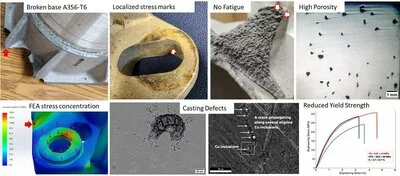
When Hurricane Ian moved across Florida in 2022, several aluminum light poles on a Central Florida bridge collapsed or cracked, even though wind speeds remained below the structures’ design limits. A new University of Florida study reveals how hidden flaws in design and installation contributed to their unexpected collapse. The research is published in the journal Engineering Failure Analysis.
Researchers from UF’s Herbert Wertheim College of Engineering found that the failures were not caused by extreme winds alone, nor by long-term fatigue. Instead, the damage resulted from a dangerous combination of manufacturing defects, stress-concentrating design features and installation-related errors that sharply reduced the poles’ safety margin under hurricane conditions.
“We were looking at newly installed, code-compliant structures that should not have failed,” said Flavia da Cruz Gallo, lead author of the study. “What we found is that no single issue was responsible. The failures occurred because multiple small vulnerabilities aligned at the same time.”
In collaboration with the Florida Department of Transportation, the research team looked inside the poles, tested the metal, checked how the poles were installed and used computer models and small prototypes inside a wind tunnel to recreate hurricane winds to figure out why the structures failed.
CT scans showed the aluminum bases were filled with tiny air pockets that weakened the metal. In some cases, those hidden gaps made up more than 8% of the material, well above what industry standards allow. Tests found the weakened metal was up to 25% less strong, making the bases much more likely to crack during strong winds.
At the same time, field inspections identified installation irregularities, including uneven leveling nuts, mismatched washers and bolt misalignment. Computer simulations demonstrated that even slight installation errors, on the order of a fraction of a turn of a nut, could introduce enough additional stress to push the already weakened material past its yield strength when combined with hurricane winds.
Fracture analysis confirmed that the poles failed suddenly through overload rather than gradually through fatigue. Cracks consistently initiated near specific anchor bolts, locations that aligned with the dominant wind direction during Hurricane Ian. Modeling showed that wind flow around the bridge amplified stresses at those points, reducing how much stress they could safely handle.
“In a perfect world, materials are flawless and installations are exact,” said Jennifer Bridge, co-corresponding author. “Design codes account for real-world variability by building in safety factors. In this case, the structures met key code requirements, but material deficiencies and installation issues caused behavior that exceeded those built-in safety margins, leading to failure.”
The findings indicate that some aluminum infrastructure in hurricane-prone regions may experience reduced performance when manufacturing variability and installation conditions are not fully accounted for, particularly during strong storm events. The researchers highlight the value of enhanced quality control during manufacturing, improved installation practices to ensure consistent bolt tightening and modest design refinements to reduce localized stress.
“This study shows that good performance in the field depends on more than meeting individual design or inspection requirements,” Gallo said. “By considering design, manufacturing, and installation together, engineers can further strengthen infrastructure reliability and better support public safety.”
Image – Graphical abstract. Courtesy of: Engineering Failure Analysis.
For more information:
University of Florida
https://www.ufl.edu/
Subject Classifications
Failure Analysis
Fractography
Materials Characterization
Metallography and Microstructures
news
News Articles
Testing and Characterization


